
Free Bioinformatics Course Guide for Students Exploring Gene Expression in Genetic Engineering
Career Advice 2026
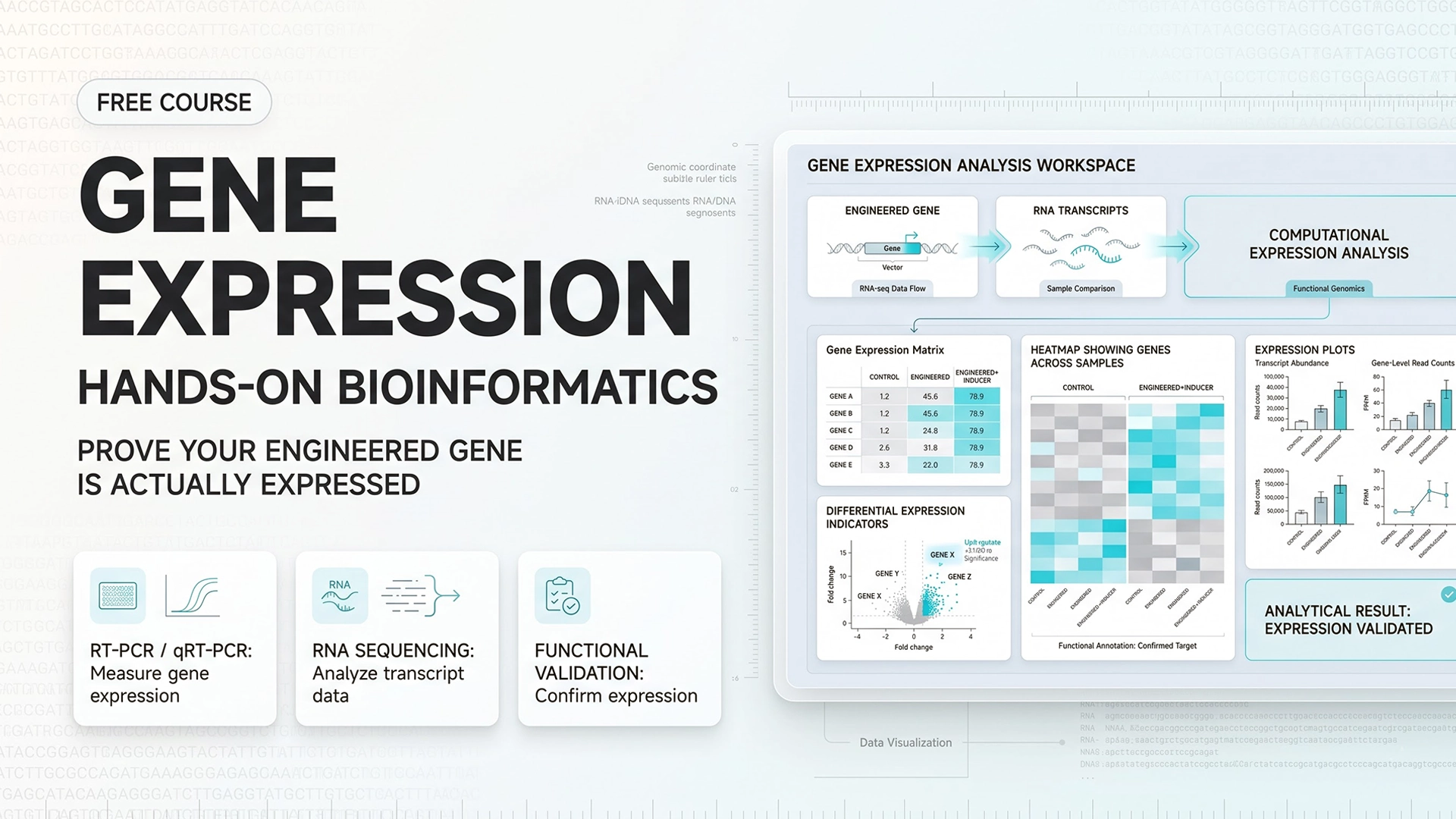
Inserting a gene is useless if the cell silences it. You must use computational expression analysis to prove your genetic engineering actually worked.
Understand why inserting DNA is completely useless unless you can use computational analysis to prove the engineered gene is actually expressing.
You successfully cloned a gene, engineered a plasmid, and inserted it into a host cell. Your petri dish is full of growing colonies. But did your genetic engineering experiment actually work?
Just because the DNA is physically inside the cell does not mean the cell is actually reading it. The host organism might recognize the foreign gene and completely silence it. To prove your genetic modification was a commercial success, you must bridge the gap between genetic engineering and functional genomics. You must answer one critical question: Did the engineered gene actually get expressed?
To validate your engineered cells, you must master the computational analysis behind three core expression technologies.
Validating with RT PCR and qRT PCR
You cannot sequence RNA directly. You must first use reverse transcription to convert the fragile cellular RNA into stable complementary DNA. Then, using quantitative real-time PCR, you utilize fluorescent probes to measure the exact amount of target gene expression occurring inside your engineered cell. The computational software attached to the PCR machine will generate an amplification curve, allowing you to mathematically prove that your specific genetic insert is actively producing transcripts.
Scaling Up to RNA Sequencing
While qRT-PCR is perfect for checking a single targeted gene, RNA sequencing allows you to analyze the entire cellular environment. Genetic engineering often causes unintended side effects in the host cell. RNA sequencing generates millions of short reads that represent everything the cell is currently doing. You must use bioinformatics software to align these reads back to your reference genome, mathematically proving that your engineered transcript exists in high quantities while ensuring no critical host pathways were accidentally shut down.

Bioinformatics Project Guide
Stop wondering what to build. Get 5 resume-ready bioinformatics projects with curated datasets, recommended tools, GitHub structure, and clear implementation workflows.
Executing Functional Data Analysis
Generating raw expression data is not enough. You must computationally normalize your data to account for technical variations like differing sequencing depths. By comparing the normalized data from your engineered cell against a non-modified control cell, you can calculate the statistical fold change. This computational step is how you definitively prove to a laboratory director that your genetic engineering experiment was a complete success.
A Free Resource to Build Your Foundation
If you are evaluating introductory options to help you learn how to computationally analyze RNA data and validate your genetic engineering workflows, here is a highly recommended structured resource:
Bioinformatic Methods II - University of Toronto
What this course is: A highly practical guide to navigating downstream computational biology and functional genomics.
How it helps you: This course focuses on the computational side of expression data. It introduces you to the core logic behind RNA sequencing, expression analysis, and functional genomics without overwhelming you with advanced transcriptomics, giving you the exact computational tools required to prove your laboratory cloning experiments actually worked.
Find Your Next Step in Bioinformatics.
Confused about where to start or what to learn next? Browse our curated collection of guides, roadmaps, and tools designed to take you from beginner to job-ready.
I’m Sujay Mukherjee, Founder of BTGenZ, where I work at the intersection of biotechnology, scientific communication, research data, and industry. Alongside building BTGenZ, I personally help researchers turn complex research into clear data visualizations, research reports, scientific presentations, and technical content, making their work easier to understand, communicate, and present professionally.
The 10 Question Gene Expression Bioinformatics Reality Check
When we evaluate resumes at BTGenZ, the candidates who have verifiable training in advanced functional genomics immediately bypass the generic applications. But once you sit down with a hiring manager, they will test if you actually understand the frameworks. Figure out the answers to these trap questions before your interview:
- What is the fundamental biological difference between analyzing genomic DNA and analyzing messenger RNA to validate a genetic engineering experiment?
- Explain why reverse transcriptase is strictly required before you can perform a quantitative PCR experiment on an engineered cell line.
- How does quantitative RT PCR use fluorescent probes to mathematically measure the exact amount of gene expression in real time?
- What is the technical advantage of using total RNA sequencing over traditional qRT PCR when analyzing a newly engineered genetic pathway?
- Why must you computationally normalize your RNA sequencing data before comparing the expression levels of your engineered gene to a control cell?
- Explain how calculating the Transcripts Per Million metric allows bioinformaticians to mathematically account for varying sequencing depths.
- How does a bioinformatics alignment tool mathematically map short RNA reads across splice junctions in a eukaryotic reference genome?
- When an engineered gene shows high DNA presence but zero RNA expression, how does epigenetic silencing computationally explain this biological failure?
- Why is the selection of stable housekeeping genes absolutely critical for the computational accuracy of a functional genomics experiment?
- A principal investigator asks you to visualize your differential expression data. How does a volcano plot computationally highlight the most significantly upregulated genes?

Recruiters Decide Faster Than You Think.
Your resume, LinkedIn profile, projects, and certifications may be stronger than you realize. The real question is whether they are communicating the right message.
Questions? Reach us directly at connect@btgenz.in
An Important Note on Resource Access and Credentials
This course offers free audit access via Coursera, allowing you to review the video lectures and study materials without cost. Official graded certificates and graded exams require payment or financial aid applications depending on platform policies.
From a profile positioning perspective, completing an online course serves as a helpful career exploration tool. However, industry recruiters evaluate candidates based on practical project visibility and demonstrated skills rather than course completion credentials alone.
Your Next Steps in the BTGenZ Ecosystem
This course can help you build the right foundational skills, but knowing what to learn is just the first step. At BTGenZ, we help you choose relevant skills and courses, then position them through your resume, LinkedIn, and portfolio so you can present yourself better for the roles you want.
If you decide to pursue this path and want to ensure your professional profile effectively communicates your new knowledge to industry recruiters, explore our profile positioning support directly at portfolio.btgenz.in.
Looking for more resources? If you want to download project-related guidance, Click here to download.
Researchers Read:
Founder of BTGenZ. Passionate about simplifying biotechnology for the next generation and bridging the information gap for aspiring biotechnologists in India.

Related Reads
Loading commenting section...
Comments Section
No approved comments yet. Be the first to leave a comment!