
Free Bioinformatics Course for Students Exploring Codon Optimization in Genetic Engineering
Career Advice 2026
Codon optimization is where genetic engineering and bioinformatics meet. Learn how to computationally rewrite DNA for recombinant expression.
Understand why you must computationally analyze and rewrite DNA sequences to achieve successful recombinant protein expression.
Codon optimization is where genetic engineering and bioinformatics start becoming interesting together.
I have been working on a series of resources around genetic engineering for BTGenZ, but I do not want to approach it only from the traditional wet lab perspective. There is a huge computational side to many genetic engineering workflows.
Codon optimization is one excellent example. You cannot just copy a human gene, paste it into a bacterial cell, and expect a massive yield of recombinant protein. Bacteria and humans read DNA differently. A coding sequence can be analyzed computationally, codon usage can be evaluated, and sequences can be optimized for a particular expression system.
What interests me here is not simply the concept itself. It is the possibility of turning a genetic engineering concept into something a student can actually work with on a computer. That is the direction I am exploring with this series.
To guarantee high yield recombinant expression in an industrial cell factory, you must master the bioinformatics workflow behind computational sequence optimization.
Matching the Transfer RNA Pool
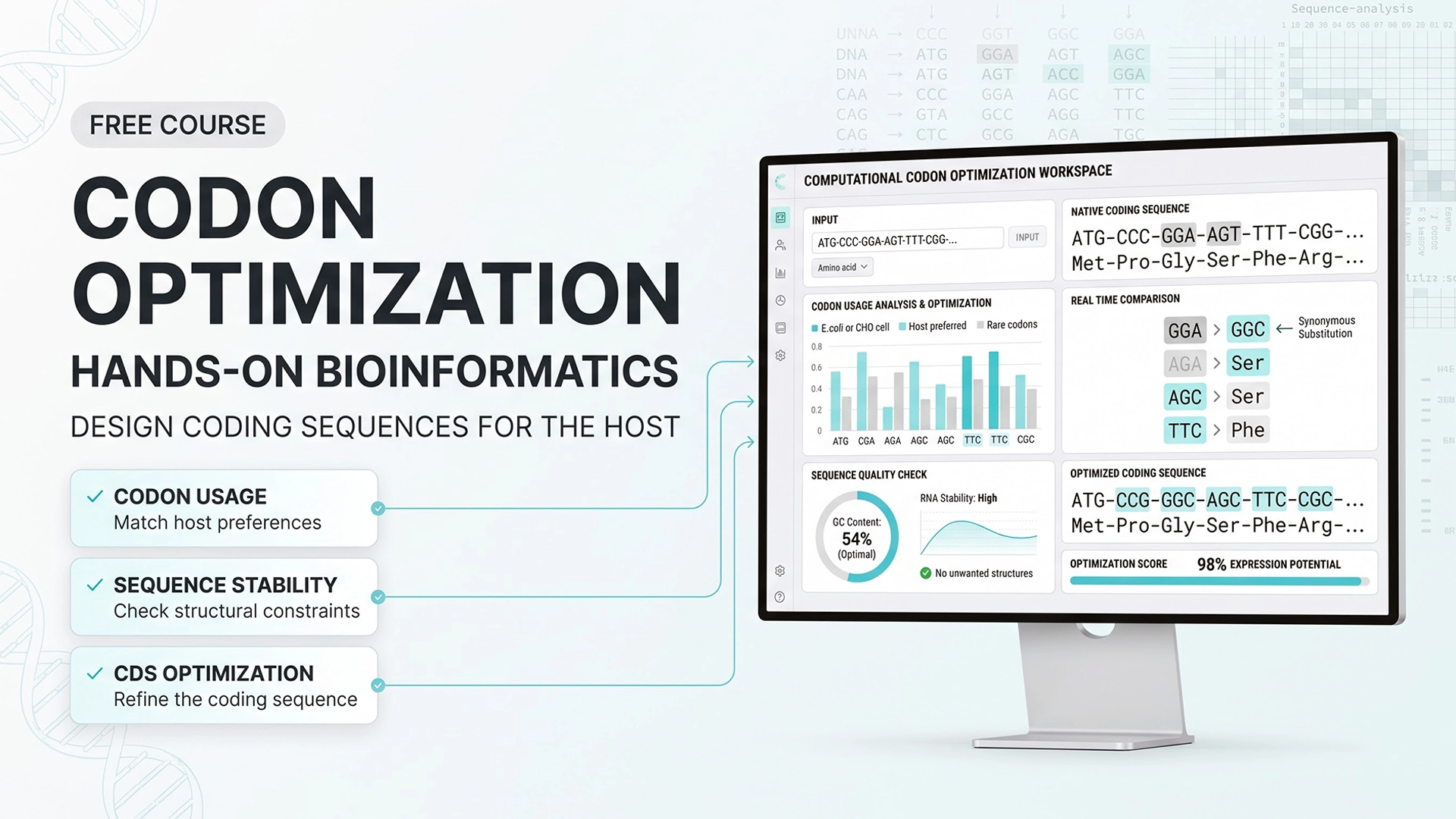
You must import your raw coding sequence into a bioinformatics tool to calculate its Codon Adaptation Index. This algorithm mathematically compares your sequence against the highly expressed genes of your target host organism. The software swaps the problematic native human codons for the host preferred synonymous codons. This ensures the host cell has an abundant supply of the necessary transfer RNAs to translate the synthetic gene at maximum speed.
Executing Thermodynamic Stabilization
Simply swapping codons is never enough. You must computationally analyze the exact percentage of guanine and cytosine nucleotides. If the GC content is too high, the transcribed messenger RNA will become thermodynamically unstable. It will fold onto itself to create rigid secondary structures and hairpin loops that physically block the host ribosome. You must use algorithms to carefully balance this ratio across the entire sequence, ensuring smooth ribosomal progression.

Bioinformatics Project Guide
Stop wondering what to build. Get 5 resume-ready bioinformatics projects with curated datasets, recommended tools, GitHub structure, and clear implementation workflows.
Eradicating Cryptic Biological Sites
When you use a computational script to completely rewrite a genetic sequence, you are introducing massive changes to the underlying nucleotide code. During this process, the software often accidentally creates new restriction enzyme cut sites, cryptic splice sites, or premature termination signals. You must run a final computational scan on your optimized design to systematically eradicate these biological errors while perfectly preserving the final translated amino acid structure.
A Free Resource to Build Your Sequence Analysis Foundation
I found a free hands on course that introduces students to this area. If you want a resource that skips generic biology and connects sequence optimization directly to real world biomanufacturing, this is a highly recommended starting point:
Find Your Next Step in Bioinformatics.
Confused about where to start or what to learn next? Browse our curated collection of guides, roadmaps, and tools designed to take you from beginner to job-ready.
I’m Sujay Mukherjee, Founder of BTGenZ, where I work at the intersection of biotechnology, scientific communication, research data, and industry. Alongside building BTGenZ, I personally help researchers turn complex research into clear data visualizations, research reports, scientific presentations, and technical content, making their work easier to understand, communicate, and present professionally.
The 10 Question Codon Optimization Bioinformatics Reality Check
When we evaluate resumes at BTGenZ, the candidates who have verifiable training in advanced computational tools immediately bypass the generic applications. But once you sit down with a hiring manager, they will test if you actually understand the science. Figure out the answers to these trap questions before your interview:
- What is the fundamental mathematical logic behind calculating a Codon Adaptation Index for a novel recombinant gene sequence?
- Explain how a bioinformatics algorithm utilizes a host specific codon usage table to determine the absolute optimal synonymous mutation.
- Why must sequence analysis software strictly preserve the original amino acid structure while drastically altering the underlying nucleotide sequence?
- How do high GC content regions computationally predict the thermodynamic formation of stable messenger RNA hairpin loops?
- What is the biological consequence if a sequence optimization algorithm accidentally introduces a cryptic splice site into a eukaryotic expression vector?
- Explain why maximizing the Codon Adaptation Index to a perfect score can sometimes cause recombinant proteins to misfold due to translation speeds.
- How does a bioinformatics tool mathematically detect and eliminate premature termination signals that were created during the algorithmic optimization process?
- When engineering a sequence for mammalian expression, why must you computationally analyze and optimize the specific nucleotides flanking the start codon?
- Why is it computationally critical to evaluate the global GC content completely differently than the localized GC content at the five prime end of your transcript?
- A lab manager notes that your optimized bacterial cell factory produced a severely truncated protein. How does a failure to computationally scan for internal restriction sites explain this failure?

Recruiters Decide Faster Than You Think.
Your resume, LinkedIn profile, projects, and certifications may be stronger than you realize. The real question is whether they are communicating the right message.
Questions? Reach us directly at connect@btgenz.in
An Important Note on Resource Access and Credentials
This course offers free audit access via Coursera, allowing you to review the video lectures and study materials without cost. Official graded certificates require payment.
Your Next Steps in the BTGenZ Ecosystem
I will be covering more genetic engineering concepts where bioinformatics can provide a practical, computer based workflow. At BTGenZ, we help you choose relevant skills and courses, then position them through your resume, LinkedIn, and portfolio so you can present yourself better for the roles you want.
If you decide to pursue this path and want to ensure your professional profile effectively communicates your new knowledge to industry recruiters, explore our profile positioning support directly at portfolio.btgenz.in.
Looking for more resources? If you want to download project-related guidance, Click here to download.
Researchers Read:
Founder of BTGenZ. Passionate about simplifying biotechnology for the next generation and bridging the information gap for aspiring biotechnologists in India.

Related Reads
Loading commenting section...
Comments Section
No approved comments yet. Be the first to leave a comment!