
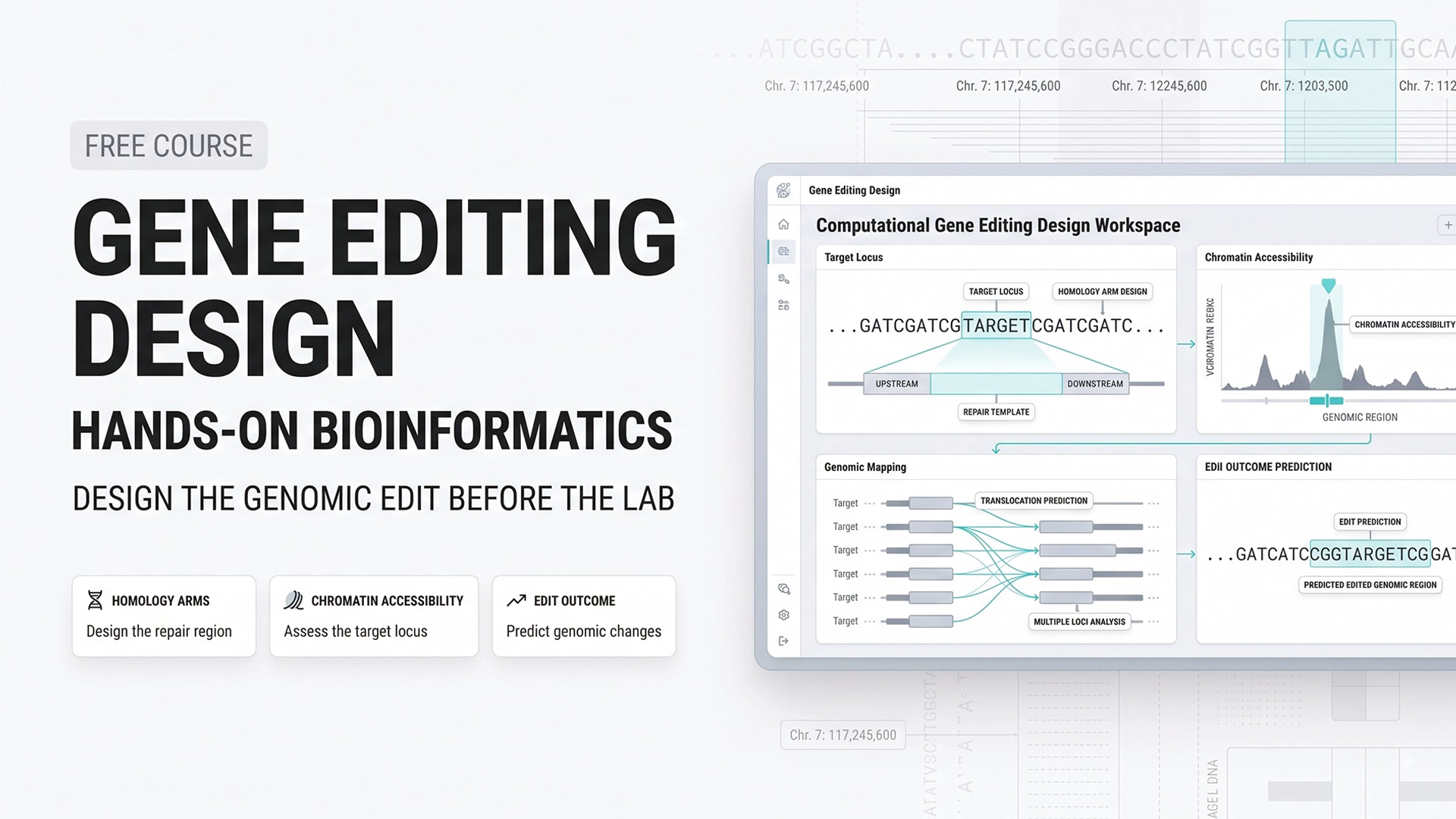
Free Hands On Bioinformatics Course for Students Exploring Gene Editing Design
Career Advice 2026
Gene editing is an advanced data science problem. You must computationally predict how the host cell will repair the DNA before you cut it.
Understand why you must computationally model homology repair templates and chromatin accessibility before you ever touch a cell.
We already know how molecular scissors work. But in the biotechnology industry, if you blindly launch an editing enzyme into a cell without running a computational simulation first, you are gambling with genomic stability.
Gene editing is no longer just a laboratory chemistry trick. It is an advanced data science problem. You must computationally design the entire genomic environment before you attempt to modify it. If you do not mathematically predict how the host cell will react to the physical DNA damage, your experiment will fail and your engineered cells will die. Generating a cut is easy. Computationally forcing the cell to repair that cut exactly how you want it to is the real challenge.
To confidently design an industry standard gene editing workflow, you must master three computational steps.
Engineering Homology Arms for Precision Repair
When you want to insert a synthetic sequence into a genome, you cannot just drop it into the nucleus and hope for the best. You must computationally design exact flanking sequences that perfectly match the host genome. Bioinformatics software calculates the optimal nucleotide length and GC content required to trick the cellular machinery into stitching your synthetic gene directly into the chromosome. If your digital template is off by even one nucleotide, the cell will reject the repair.
Executing Chromatin Accessibility Analysis
A target gene might look completely exposed on your digital screen, but inside a living cell, DNA is tightly wrapped around massive histone proteins. You must use epigenetic data and ATAC sequencing analysis to computationally verify that your target site is physically open. If the biological region is closed, your editing enzyme will simply bounce off the chromatin structure and the edit will completely fail.

Bioinformatics Project Guide
Stop wondering what to build. Get 5 resume-ready bioinformatics projects with curated datasets, recommended tools, GitHub structure, and clear implementation workflows.
Predicting Multiplex Translocations
Modern biopharma companies rarely edit just one gene. They often edit three or four genes simultaneously to engineer complex immune cells. You must run advanced bioinformatics algorithms to predict the physical outcome of these simultaneous double strand breaks. If two cuts happen on different chromosomes at the exact same time, the cell might accidentally fuse the wrong chromosomes together. This computational prediction prevents a catastrophic failure known as chromosomal shattering.
A Free Resource to Build Your Sequence Design Foundation
If you are evaluating introductory options to help you learn how to computationally analyze genomes and execute this algorithmic logic, here is a highly recommended structured resource:
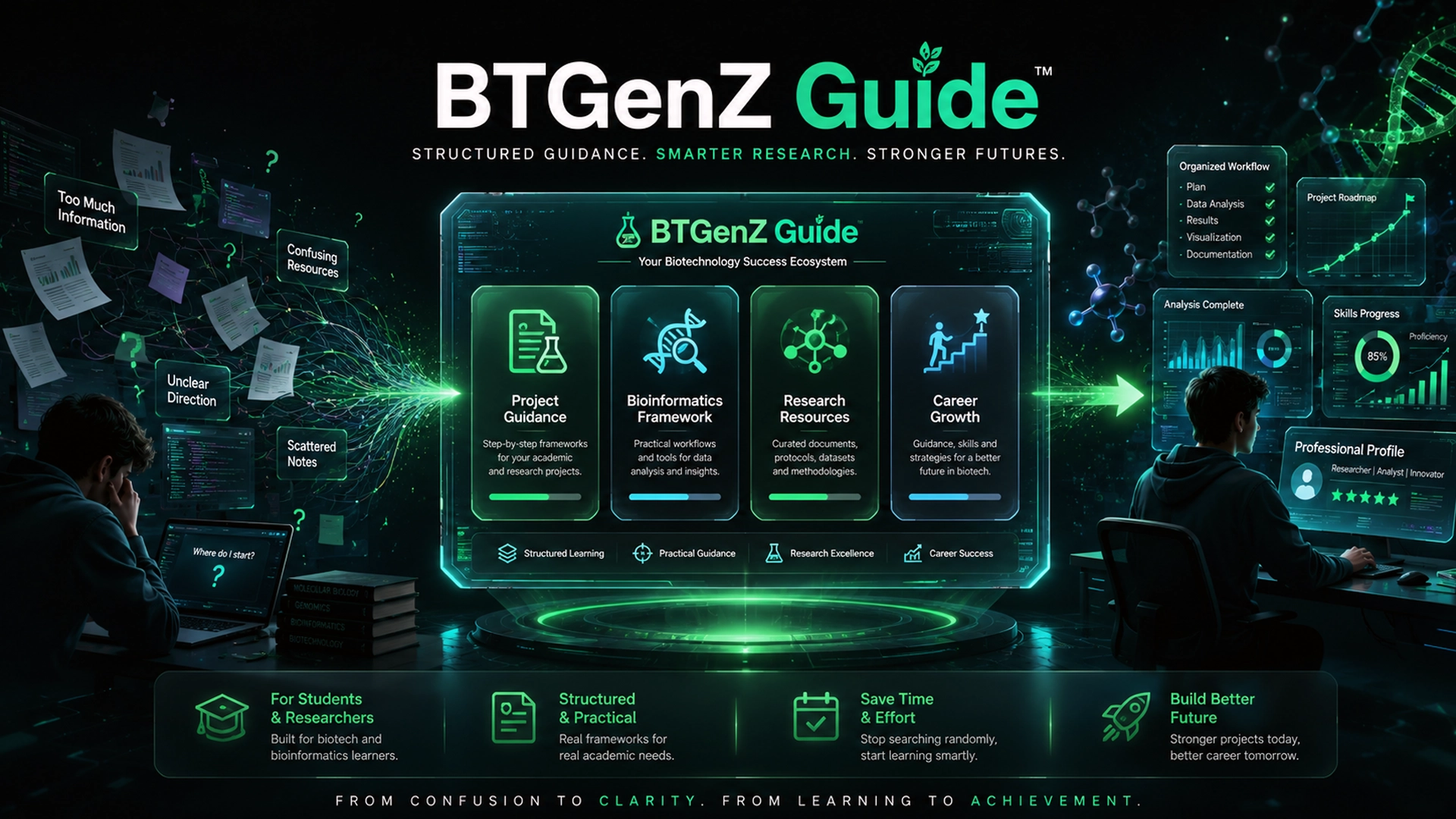
Find Your Next Step in Bioinformatics.
Confused about where to start or what to learn next? Browse our curated collection of guides, roadmaps, and tools designed to take you from beginner to job-ready.
I’m Sujay Mukherjee, Founder of BTGenZ, where I work at the intersection of biotechnology, scientific communication, research data, and industry. Alongside building BTGenZ, I personally help researchers turn complex research into clear data visualizations, research reports, scientific presentations, and technical content, making their work easier to understand, communicate, and present professionally.
The 10 Question Gene Editing Design Reality Check
When we evaluate resumes at BTGenZ, the candidates who have verifiable training in advanced computational tools immediately bypass the generic applications. But once you sit down with a hiring manager, they will test if you actually understand the science. Figure out the answers to these trap questions before your interview:
- What is the exact bioinformatics algorithm used to determine the optimal length and GC content of a homology directed repair template?
- Explain how computational biologists use ATAC sequencing data to mathematically predict whether a target editing site is physically accessible.
- Why must you computationally analyze the exact distance between your cut site and the intended mutation to guarantee a successful genomic integration?
- How do bioinformatics tools mathematically predict the probability of non homologous end joining versus homology directed repair in a specific mammalian cell line?
- What is the biological consequence if your designed homology arms accidentally contain highly repetitive Alu elements?
- Explain the computational risk of executing a multiplex editing experiment on two genes located closely together on the exact same chromosome.
- How does a bioinformatics software pipeline detect and flag potential chromosomal translocations before a multiplex editing experiment begins?
- When designing a precision base editor experiment, how do you computationally ensure the target nucleotide falls precisely within the narrow editing window?
- Why is it computationally critical to analyze the epigenetic methylation status of a target promoter region before attempting to insert a synthetic gene?
- A lab manager notes that your engineered cells underwent massive apoptosis immediately after editing. How does computational modeling of simultaneous double strand breaks explain this cellular toxicity?

Recruiters Decide Faster Than You Think.
Your resume, LinkedIn profile, projects, and certifications may be stronger than you realize. The real question is whether they are communicating the right message.
Questions? Reach us directly at connect@btgenz.in
An Important Note on Resource Access and Credentials
This course offers free audit access via Coursera, allowing you to review the video lectures and study materials without cost. Official graded certificates and graded exams require payment or financial aid applications depending on platform policies.
From a profile positioning perspective, completing an online course serves as a helpful career exploration tool. However, industry recruiters evaluate candidates based on practical project visibility and demonstrated skills rather than course completion credentials alone.
Your Next Steps in the BTGenZ Ecosystem
This course can help you build the right foundational skills, but knowing what to learn is just the first step. At BTGenZ, we help you choose relevant skills and courses, then position them through your resume, LinkedIn, and portfolio so you can present yourself better for the roles you want.
If you decide to pursue this path and want to ensure your professional profile effectively communicates your new knowledge to industry recruiters, explore our profile positioning support directly at portfolio.btgenz.in.
Looking for more resources? If you want to download project-related guidance, Click here to download.
Researchers Read:
Founder of BTGenZ. Passionate about simplifying biotechnology for the next generation and bridging the information gap for aspiring biotechnologists in India.

Related Reads
Loading commenting section...
Comments Section
No approved comments yet. Be the first to leave a comment!