Top 5 Multi Omics Certifications for Bioinformatics

Career Advice 2026
5 Certifications for Students Exploring Multi Omics Analysis
I recently reviewed a portfolio from a brilliant student who was an absolute master of Genomics. They could assemble a genome, call variants, and write Python scripts to process massive DNA datasets with incredible speed.
But when I asked them how that specific DNA mutation actually translates into active proteins in a diseased cell, or how the cellular metabolism changes as a result, they were completely stumped.
They lived entirely in a single layer of biology.
The modern biotech industry is no longer just looking at DNA. The next level of biological data analysis is Multi Omics. Companies are now building massive computational pipelines to integrate genomics, transcriptomics, proteomics, and metabolomics into one unified model. They do not just want to see the genetic code. They want to see how the entire biological system communicates in real time.
The problem is not your coding ability. The problem is your data isolation.
When you apply for roles in this space, you cannot just position yourself as someone who parses FASTA files. You need to position yourself as a researcher who understands how to synthesize multiple complex data types to solve real clinical problems.
When we review profiles at BTGenZ, we constantly see students burying their potential under generic resumes that completely fail to tell this systems level story. To help you bridge that gap and give you the exact digital proof you need to optimize your profile today, here are 5 training paths from top institutions. I have also included a specific portfolio project for each one to help you build verifiable digital proof.
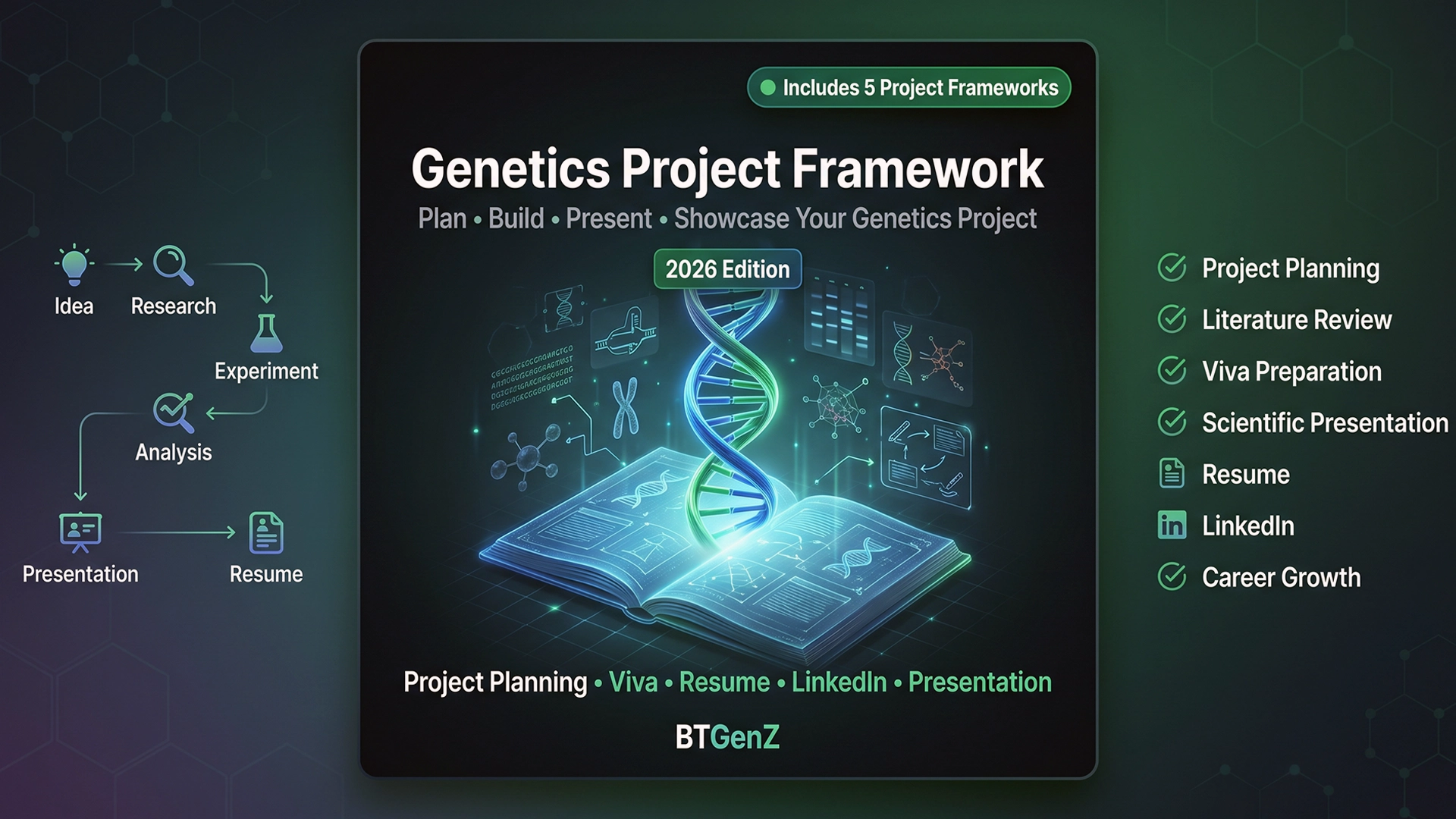
Build Your Genetics Project With Confidence.
Stop struggling with documentation and planning. Get the structured 2026 framework to plan, execute, and present your genetics project like a professional.
1. Introduction to Genomic Technologies (Johns Hopkins University)
What it is: This is your baseline. You learn how to computationally process raw DNA data and understand the fundamental algorithms used in next generation sequencing.
Beginner Project Idea (The Variant Flowchart): Open Draw.io and map out the entire computational workflow required to identify a Single Nucleotide Polymorphism from raw sequencing reads. Export it horizontally as a clean 16:9 visual and share it on LinkedIn to show recruiters you understand the genomic foundation.
Get the "Python for Bioinfo Guide" Absolutely Free included with your order today!
2. Introduction to Bioinformatics (BITS Pilani)
What it is: This course moves you into transcriptomics. You will learn how to analyze RNA sequencing data to measure real time gene expression and synthesize multi omics datasets.
Beginner Project Idea (The Expression Heatmap): Download a public RNA sequencing dataset comparing healthy and diseased tissue. Write an R script to generate an expression heatmap of the most highly regulated genes. Export a crisp 16:9 screenshot of your plot to prove you can handle dynamic transcriptomic data.

Stop Guessing. Get Job-Ready in 90 Days.
Tired of random tutorials and useless certificates? Get the exact step-by-step framework to master the tools employers actually want in the correct order.
3. Bioinformatic Methods II (University of Toronto)
What it is: This covers the proteomics layer. You will learn how to analyze protein structures, map molecular interactions, and understand the functional products of gene expression.
Beginner Project Idea (The Structural Impact Visualizer): Use PyMOL to highlight exactly where a known genetic mutation alters a three dimensional protein structure. Export a high resolution 16:9 image and write a brief GitHub README explaining the biological consequence.

Bioinformatics Project Guide
Stop wondering what to build. Get 5 resume-ready bioinformatics projects with curated datasets, recommended tools, GitHub structure, and clear implementation workflows.
Get the "Python for Bioinfo Guide" Absolutely Free included with your order today!
4. Introduction to Systems Biology (Mount Sinai)
What it is: This is where everything connects. You will learn how to use network biology to integrate multiple data types and computationally model the entire metabolic system of a cell.
Beginner Project Idea (The Multi Omics Network Map): Take a known disease pathway and plug the involved genes into the STRING database to find their interacting protein network. Export the data to Cytoscape, format the network horizontally in a crisp 16:9 layout, and document how genomics and proteomics interact.
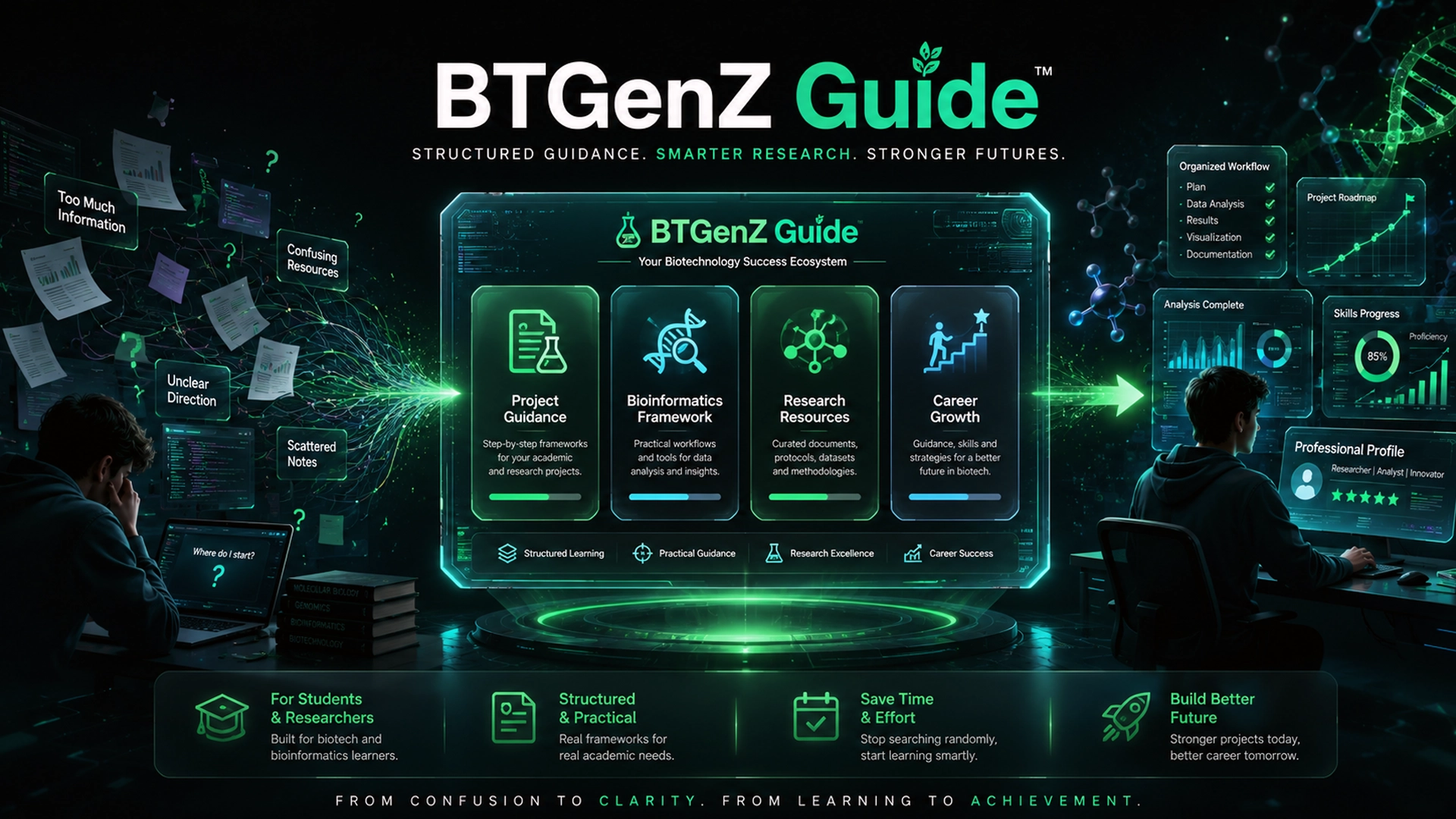
Find Your Next Step in Bioinformatics.
Confused about where to start or what to learn next? Browse our curated collection of guides, roadmaps, and tools designed to take you from beginner to job-ready.
5. Precision Medicine (University of Geneva)
What it is: This teaches you how multi omics data is actually applied in the real world to develop targeted clinical therapies and personalized diagnostics for patients.
Beginner Project Idea (The Biomarker Matrix): Create a 16:9 PDF matrix mapping three specific cancer treatments to their corresponding genomic, transcriptomic, and proteomic biomarkers. This proves to computational recruiters that you understand exactly how data translates into patient care.
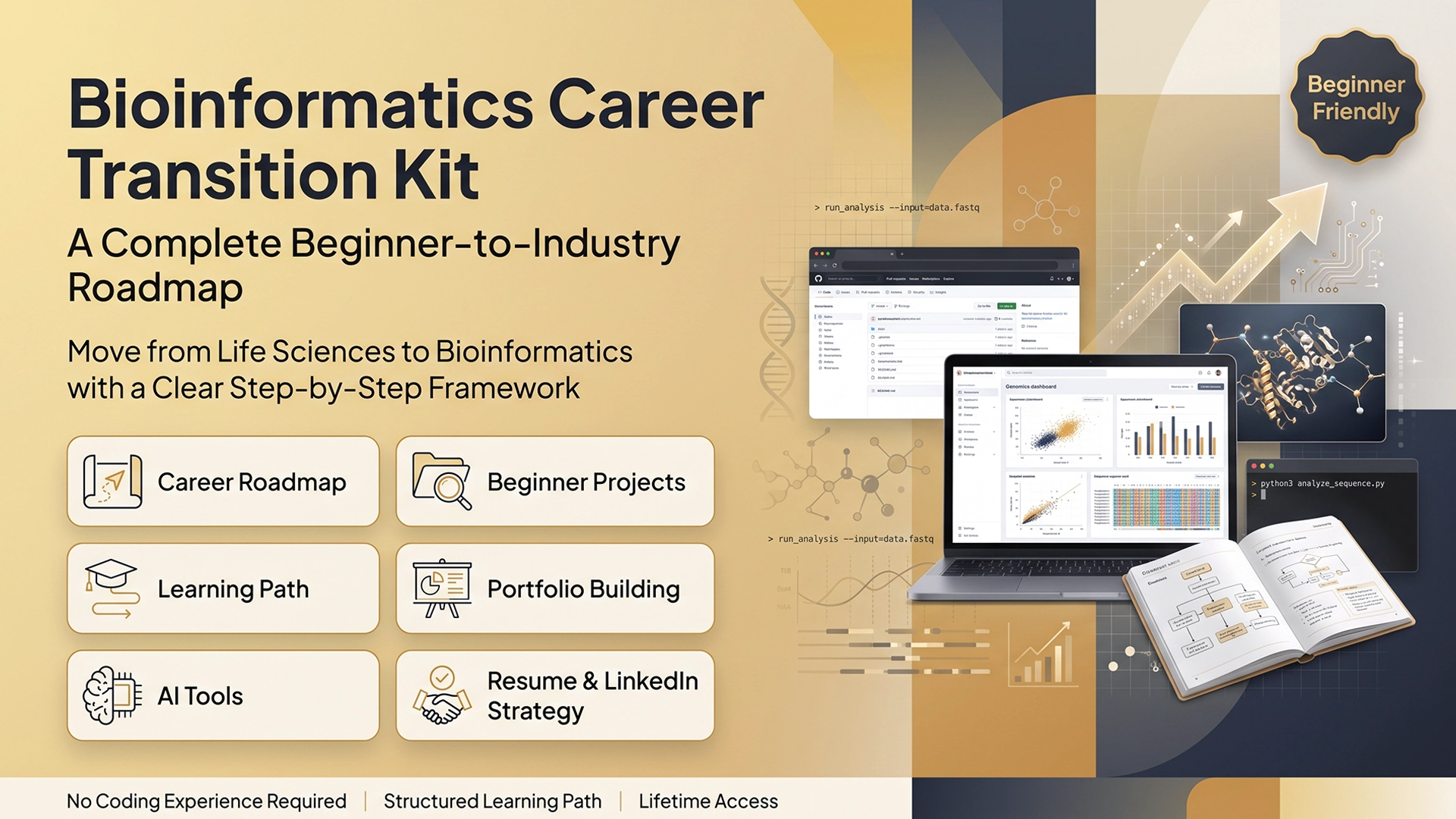
Skip the Confusion. Start Your Journey the Right Way.
Don't waste weeks on trial and error. Get the exact step-by-step guide to mastering the right tools and moving from total beginner to confident learner.
Get the "Python for Bioinfo Guide" Absolutely Free included with your order!
The 10 Question Multi Omics Reality Check
When we evaluate resumes at BTGenZ, the students who have verifiable training in systems level workflows immediately bypass the massive pile of generic applications. But once you sit down with a hiring manager, they will test if you actually understand the pipelines. Figure out the answers to these trap questions before your interview:
- Data Integration: What is the fundamental computational challenge when integrating static genomic data with highly dynamic transcriptomic data?
- Normalization: How do you computationally normalize RNA sequencing read counts to accurately compare gene expression across different cellular conditions?
- Mass Spectrometry: Why is mass spectrometry data so computationally complex to analyze compared to traditional Next Generation Sequencing data?
- Network Theory: How do systems biology algorithms use network theory to integrate proteomics and metabolomics into a single cellular pathway model?
- Biological Layers: What is the biological and computational difference between analyzing a genome and an epigenome when studying patient tumor samples?
- Data Preprocessing: When performing a multi omics analysis, why is dimensionality reduction using Principal Component Analysis absolutely critical?
- Proteogenomics: How do computational biologists map fragmented peptide sequences back to a reference genome to identify novel protein isoforms?
- Microbiome Impact: What specific bioinformatics pipelines are used to analyze the microbiome and its direct impact on human metabolic byproducts?
- Machine Learning: How does machine learning help researchers discover novel biomarkers by finding hidden correlations across four different omics layers simultaneously?
- The Reality Test: A lab manager asks: "Our genomic data shows a massive mutation, but the patient has no symptoms." How could transcriptomics and proteomics computationally explain this missing phenotype?

Recruiters Decide Faster Than You Think.
Your resume, LinkedIn profile, projects, and certifications may be stronger than you realize. The real question is whether they are communicating the right message.
Questions? Reach us directly at connect@btgenz.in
Your Technical Skills Deserve to be Seen
I know exactly how frustrating it is to spend months mastering complex data pipelines, only to send out dozens of applications and hear absolutely nothing back. The reality is that just listing laboratory skills or coding languages on a generic text heavy resume no longer works. Recruiters are overwhelmed. If your computational depth is buried under basic formatting, you remain completely invisible.
You have to show them what you can do. Building a clean visual project or documenting a data integration pipeline online proves to a hiring manager that you can actually execute the work. If you need help figuring out exactly what steps to take next, I highly recommend downloading our complete Bioinformatics Roadmap over at guide.btgenz.in. It is available immediately and gives you a clear direction to start building your visibility.
However, some of you might be tired of guessing and want expert help turning your academic background into a selection ready profile. We can absolutely work together directly to make that happen. Because rewriting your career narrative and building a custom digital portfolio requires hours of dedicated one on one strategy, this is a paid career positioning service. It is built specifically for students and researchers who value their time, want to skip the trial and error, and are ready to invest in their next big career leap.
If you are ready to let us do the heavy lifting with you and build a standout profile that attracts real industry opportunities, you can book your repositioning service directly at portfolio.btgenz.in. You can also drop an email to connect@btgenz.in if you want to chat about your specific situation before making a decision.
Do not let your hard work stay hidden. Start building your proof today.
Looking for more resources? If you want to download project-related guidance, Click here to download.
Get the "Python for Bioinfo Guide" Absolutely Free included with your order today!
Researchers Read:
Founder of BTGenZ. Passionate about simplifying biotechnology for the next generation and bridging the information gap for aspiring biotechnologists in India.

Related Reads
Loading commenting section...
Comments Section
No approved comments yet. Be the first to leave a comment!